Robotic Knee Replacement Surgery in Kolkata — A Complete Guide for Patients Considering the Procedure
Chronic knee pain changes everything. The morning stiffness that takes longer to fade each year, the reluctance to climb stairs, the quiet withdrawal from evening walks and family outings — these are the realities millions of Indians live with as osteoarthritis gradually takes hold. When medication, physiotherapy, and lifestyle adjustments stop providing meaningful relief, robotic knee replacement surgery in Kolkata offers the most effective path forward.
But knee replacement in 2026 is not the same procedure it was a decade ago. The introduction of robotic-assisted technology has fundamentally changed how surgeons plan, execute, and deliver outcomes in knee arthroplasty. Robotic Knee Replacement Surgery in Kolkata is now a reality — available right here in Salt Lake for patients across the city and West Bengal.
This guide covers everything you need to understand about Robotic knee Replacement Surgery in Kolkata: how it works, who it is for, what makes it different, and what you can realistically expect.
What Is Robotic Knee Replacement
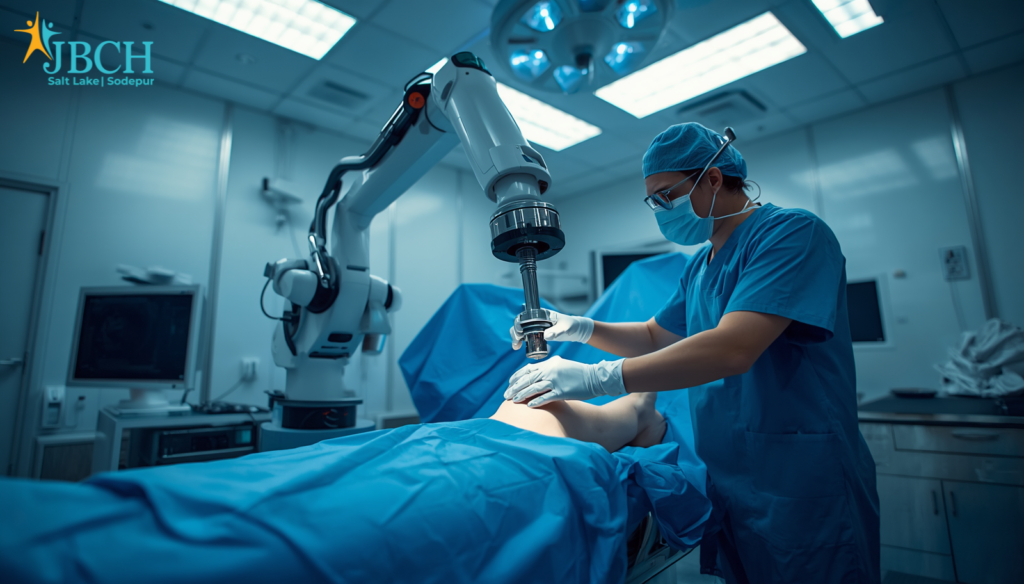
Robotic knee replacement is a surgical procedure where the orthopaedic surgeon uses a robotic arm, guided by advanced computer navigation, to perform the operation with an extraordinary level of accuracy. The process begins weeks before surgery, when a CT scan of the patient’s knee is taken and converted into a detailed 3D model. This model becomes the surgeon’s digital blueprint.
On this blueprint, the surgeon pre-plans every bone cut — the precise angle, depth, and position — tailored to that specific patient’s anatomy. During the actual surgery, the robotic arm guides the cutting instruments along the pre-planned path. If the instrument moves even slightly beyond the intended boundary, the system resists or retracts, preventing any unplanned bone removal.
The result is a level of surgical precision that manual techniques, regardless of the surgeon’s experience, find difficult to match consistently. This is the core of what makes robotic surgery different: it turns surgical planning from an approximation into an exact science.
How Is It Different from Conventional Knee Replacement
In a conventional knee replacement, the surgeon uses mechanical jigs and alignment rods — physical instruments placed inside and outside the knee — to guide bone cuts. These tools work well in experienced hands, but they have inherent limitations. They rely on anatomical landmarks that can be obscured by severe arthritis, and they offer limited real-time feedback on soft-tissue balance.
Robotic surgery addresses both of these limitations. The 3D imaging provides a clear, complete picture of the joint regardless of deformity severity. And during surgery, the robotic system displays real-time data on ligament tension, joint gaps, and overall knee balance — information that helps the surgeon make micro-adjustments before finalising the implant position.
These are the precision robotic knee surgery benefits that clinical studies consistently highlight: tighter alignment accuracy, better ligament balance, and more predictable outcomes across different patient profiles. This precision is also the reason behind long-lasting knee implants with robotics — when the implant is positioned correctly from the start, it wears evenly and serves the patient well for decades.
Who Is a Candidate for Robotic Knee Replacement
Most patients who qualify for conventional knee replacement are also candidates for the robotic-assisted version. This includes individuals with moderate to severe osteoarthritis, rheumatoid arthritis affecting the knee, avascular necrosis, or post-traumatic arthritis following an old injury. Both total knee replacement and partial (unicompartmental) knee replacement can be performed with robotic assistance.
Patients with significant deformities — severe varus (bow-legged) or valgus (knock-kneed) alignment — often benefit particularly from the robotic approach, as the 3D planning handles complex anatomy more reliably than conventional jigs.
Your orthopaedic surgeon will assess your knee condition through clinical examination, X-rays, and sometimes an MRI to determine whether robotic surgery is the right approach for your specific case.
Robotic Knee Replacement Surgery in Kolkata — A Complete Guide for Patients Considering the Procedure
What Does Recovery Look Like
Recovery after robotic knee replacement follows a structured physiotherapy-driven pathway. Most patients begin standing and taking assisted steps within twelve to twenty-four hours of surgery. Because the procedure preserves more soft tissue than conventional surgery — less muscle disruption, more careful ligament handling — post-operative swelling and stiffness tend to be noticeably reduced.
Hospital discharge typically happens within two to four days. Home-based physiotherapy continues for several weeks, focusing on range-of-motion exercises, strengthening, and gait training. Most patients return to daily household activities within three to four weeks, and more demanding activities within two to three months.
This Faster Recovery Knee Replacement Surgery offers is not just a clinical statistic — it translates directly into less time spent dependent on others, fewer disrupted days for families, and a quicker return to the routines that define normalcy.
Robotic Knee Replacement Is Now Accessible in Salt Lake, Kolkata
Advanced Robotic knee Replacement Surgery in Kolkata is now available in Salt Lake. These centres combine proven robotic platforms with experienced, fellowship-trained joint replacement surgeons to deliver precision-driven outcomes.
For patients across Kolkata, Howrah, Hooghly, North and South 24 Parganas, and the broader districts of West Bengal, this means that access to robotic joint replacement surgery in West Bengal is now within comfortable reach — close to home, close to family, and supported by modern hospital infrastructure.
If you or a family member has been living with persistent knee pain and considering surgery, understanding your options is the first step. A detailed consultation with an experienced orthopaedic specialist can help you determine whether robotic knee replacement is the right approach for your condition. JBCH Hospital in Salt Lake, Kolkata, is one such centre where you can explore robotic knee replacement and the expertise behind it.