Robotic Knee Replacement Surgery in Kolkata – A Complete Stage by Stage Patient Guide
Ask most knee replacement patients what worried them the most, and very few will say the operation itself. What troubles them is the unknown — what actually happens once the theatre doors close. Add a robotic arm, infrared cameras, and glowing monitors to the picture, and the anxiety often grows instead of shrinking.
This guide removes that mystery. It walks you through Robotic Knee Replacement Surgery in Kolkata one stage at a time — beginning with the very first scan and ending at the moment you stand on your new knee — so you know exactly what to expect before the day arrives.
Stage 1: Consultation and Diagnostic Assessment
Everything begins in the consultation room, not the operation theatre. During the first visit, the Best Robotic Knee Replacement Surgeon in Kolkata examines the affected knee thoroughly — testing how far it bends and straightens, watching how you walk, checking ligament stability, and going through your full medical history.
Standing weight-bearing X-rays come next. These reveal how much joint space has been lost, the extent of bone wear, and whether the limb has drifted out of its natural alignment.
If you are found suitable for robotic-assisted surgery, a high-resolution CT scan of the knee is ordered. A normal X-ray gives a flat, two-dimensional picture. The CT scan, by contrast, captures a detailed three-dimensional map of your femur (thigh bone), tibia (shin bone), and patella (kneecap) — their exact shape, size, curvature, and alignment.
Stage 2: Building Your Personal Surgical Blueprint
Your CT data is then loaded into the robotic system’s planning software, which constructs a 3D virtual model of your knee — not a standard template, but a digital twin of your own anatomy.
Working on this model, the surgeon plans every detail well before surgery: the correct implant size, the precise angle and depth of every bone cut, component rotation, and the final limb alignment expected after the operation. The software even allows different implant positions to be simulated and compared for stability and range of movement.
This advance planning is among the most important Precision Robotic Knee Surgery benefits. Instead of relying mainly on judgement made during the operation, the surgeon walks into the theatre with a patient-specific plan already validated on screen.
Stage 3: Anaesthesia and Registration on Surgery Day
On the day of surgery, anaesthesia is given first — most commonly a regional block that numbs the lower body while keeping you comfortable and stable.
The team then performs what is called registration. Small optical tracking markers are positioned near the joint, and infrared cameras begin tracking the live position of your femur and tibia. At this point, the pre-operative digital plan is matched to your real anatomy on the table.
To confirm accuracy, the surgeon moves your knee through several positions and verifies that the on-screen model mirrors the real joint exactly. Surgery proceeds only after this match is confirmed — a built-in safety checkpoint that any Advanced Robotic Knee Clinic Near Me follows as standard protocol.
Stage 4: Robot-Guided Bone Preparation
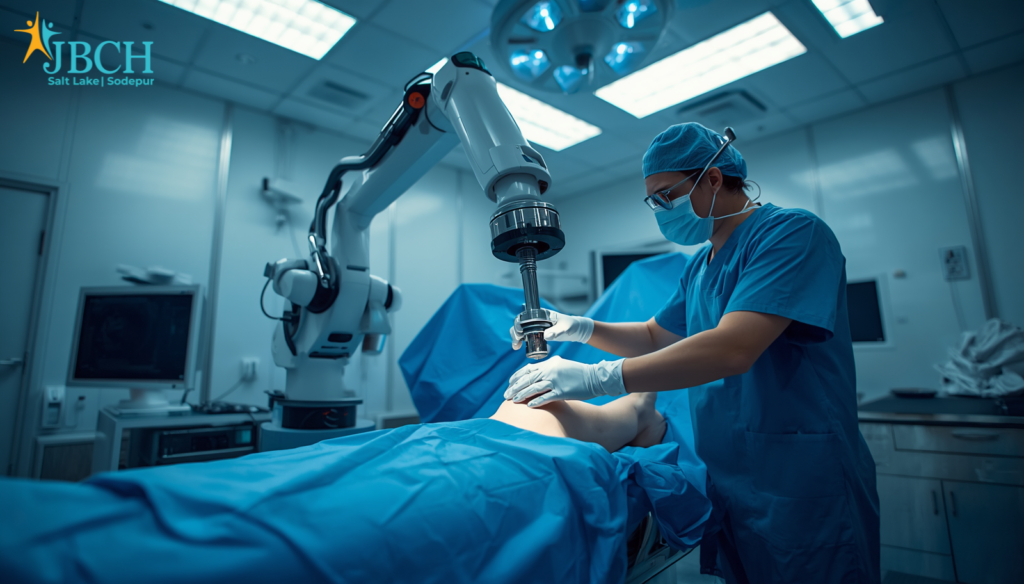
This is the stage patients are usually most curious about. The surgeon — not the robot — performs the surgery, using a cutting instrument held within the robotic arm. The arm’s role is to keep that instrument strictly within the boundaries set in the surgical plan.
If the instrument drifts toward the edge of the planned cutting zone, the system pushes back with haptic resistance or halts the blade automatically. This safeguard prevents removal of healthy bone — a well-known cause of implant malalignment in conventional knee replacement.
Because only the damaged surfaces are resected and the surrounding ligaments and muscles are largely left undisturbed, the technique is described as minimally invasive Robotic Knee Replacement.
This soft-tissue preservation is also why the approach is sometimes called pain-free knee replacement technology. A more honest description: post-operative pain is typically far milder than patients fear, though some manageable soreness in the early days of recovery is a normal part of healing.
Stage 5: Trial Fitting and Soft-Tissue Balancing
Before the final implant goes in, trial components are fitted on the prepared bone surfaces. The surgeon then moves the knee through its complete range — flexing, extending, rotating — while the robotic system displays live readings of joint gaps, ligament tension, and alignment.
A well-balanced knee is one in which the inner and outer ligaments share load evenly throughout movement. That balance is what makes a replaced knee feel natural rather than mechanical. Traditional surgery depends on the surgeon’s trained hands to judge this; robotic assistance supplements that skill with objective, measurable data.
If any imbalance appears on screen, fine adjustments are made immediately. This data-driven balancing is a key reason behind long-lasting knee implants with robotics — published clinical research consistently links accurate alignment and balanced soft tissue with better implant function and longer implant survival.
Stage 6: Final Implant Placement and Closure
Once the trial results are satisfactory, the permanent components are placed. Depending on the implant design and your bone quality, they are either fixed with bone cement or press-fitted to allow natural biological integration with the bone. After a final confirmation of stability and smooth motion, the wound is closed carefully in layers.
Stage 7: Recovery and Early Mobilisation
Recovery starts remarkably early. Within hours of surgery, the physiotherapy team helps you sit up, perform ankle pumps, and attempt gentle knee bends — and many patients stand with support the very same day. Supervised walking with a walker usually begins the next morning.
This early movement is deliberate, not optional. It boosts circulation, prevents stiffness, and re-trains the muscles around the new joint. Since more muscle and ligament have been preserved, most patients tolerate early mobilisation with noticeably less discomfort.
Discharge generally happens within a few days, followed by a structured home physiotherapy programme and scheduled follow-up visits to monitor healing and implant performance.
Cost Factors: Is Robotic Knee Replacement Affordable in Kolkata?
One of the most common patient questions concerns the Cost Of Robotic Knee Replacement in Kolkata. There is no single figure — the final amount depends on the implant chosen, hospital category, room preference, insurance coverage, and length of stay.
The encouraging news is that as robotic systems become more widely adopted, Affordable Robotic Knee Surgery in Kolkata is increasingly within reach, and many insurance policies and cashless schemes now cover robotic-assisted procedures. The most reliable approach is to request an itemised estimate during your consultation, so there are no surprises later.
What Truly Defines a Robotic Joint Replacement Centre
Owning a robotic system alone does not make a hospital a robotic joint replacement centre. What defines one is the complete package: the technology, a surgical team with substantial case experience, and a structured care pathway running from the first consultation through long-term follow-up.
Like every surgery, robotic knee replacement carries some inherent risk. Robotic guidance, stage-by-stage verification, and an experienced team exist precisely to keep that risk within accepted limits. Knowing how each stage works gives you a stronger, calmer foundation for making your decision.
If knee pain is limiting your daily life, a consultation with an orthopaedic specialist is the right first step to assess whether the procedure suits your condition. JBCH Hospital in Salt Lake, Kolkata, is one of the centres in West Bengal where Robotic Knee Replacement Surgery in Kolkata is available, supported by an experienced orthopaedic and robotics team.