How Robotic Knee Replacement Works in Kolkata A Stage by Stage Explanation
For most patients, the hardest part of a knee replacement is not the operation itself but the uncertainty around it — not knowing what takes place inside the theatre. When a robotic arm and a set of monitors are involved, that uncertainty often increases.
This article explains the process in plain terms. It follows Robotic Knee Replacement Surgery in Kolkata through each stage, from the first diagnostic scan to the point at which a patient stands on the new joint, so the sequence of events is clear before the day of surgery.
Stage One: Consultation and Diagnostic Work-Up
The process starts with a clinical assessment. The evaluation carried out by a Best Robotic Knee Replacement Surgeon in Kolkata typically covers an examination of the joint, a check of how far it bends and straightens, an observation of gait, and a review of the patient’s medical history. Standing weight-bearing X-rays are used to show the degree of joint-space narrowing, bone wear, and any deviation in limb alignment.
If robotic surgery is considered appropriate, a high-resolution CT scan of the knee is performed. Unlike a standard X-ray, which produces a flat image, the CT scan generates a three-dimensional record of the femur (thigh bone), tibia (shin bone), and patella (kneecap), including their size, curvature, and current alignment.
Stage Two: Creating a Patient-Specific Surgical Plan
The CT data is imported into the robotic system’s planning software, which builds a three-dimensional model of the individual knee rather than a generic template.
On this model, the surgeon defines the procedure in detail: implant size, the angle and depth of each bone cut, the rotation of the components, and the expected post-operative limb alignment. Different implant positions can be tested in the software to estimate their effect on stability and movement.
This pre-operative planning is one of the Precision Robotic Knee Surgery benefits. It shifts the operation from one guided largely by intra-operative judgement to one guided by a patient-specific plan prepared in advance.
Stage Three: Anaesthesia and Registration on the Day of Surgery
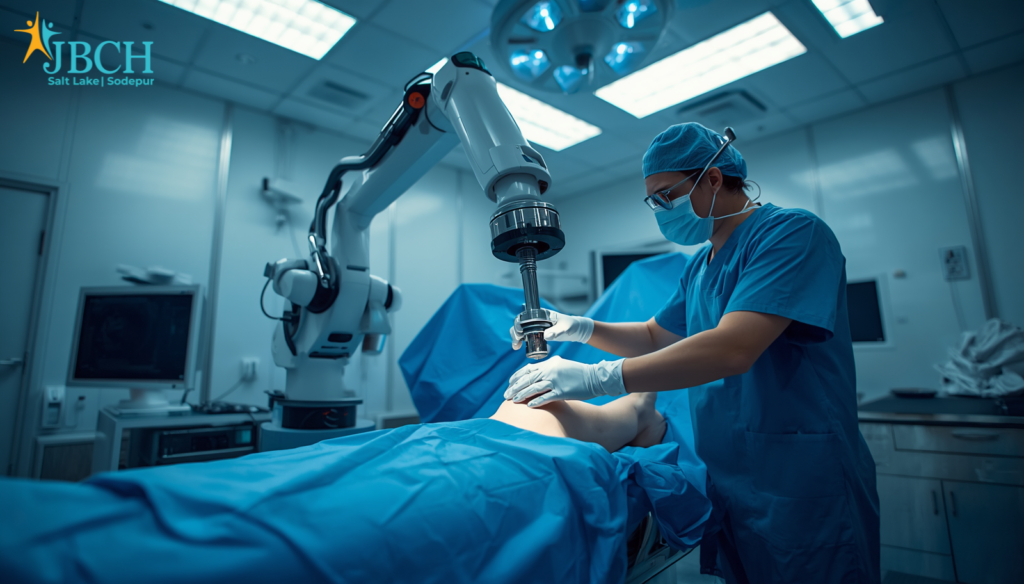
Anaesthesia is administered first — commonly a regional block that numbs the lower body while the patient remains comfortable. The team then carries out registration. Optical tracking markers are placed near the joint, and infrared cameras allow the system to track the position of the femur and tibia in real time. The pre-operative plan is aligned with the patient’s actual anatomy at this point.
The surgeon verifies the alignment by moving the knee through several positions and confirming that the on-screen model matches the joint. The procedure continues only once this accuracy is confirmed — a verification step that an Advanced Robotic Knee Clinic Near Me builds into its protocol.
Stage Four: Robot-Guided Bone Preparation
During this stage, the surgeon uses a cutting instrument held within the robotic arm to remove the damaged bone surfaces. The surgeon controls the movement, while the arm keeps the instrument within the boundaries defined in the plan.
If the instrument moves toward the edge of the planned zone, the system provides haptic resistance or stops the blade automatically. This is designed to prevent the removal of more bone than necessary, which is a recognised cause of implant malalignment in conventional surgery. The result is a more conservative resection in which the surrounding ligaments and soft tissue are disturbed less — the basis for the term minimally invasive Robotic Knee Replacement.
Because muscle and ligament are preserved, the approach is sometimes described as pain-free knee replacement technology. It is more accurate to say that post-operative discomfort tends to be milder than many patients expect; some manageable soreness during early recovery remains a normal part of healing.
Stage Five: Trial Fitting and Soft-Tissue Balancing
Trial components are placed on the prepared surfaces, and the knee is moved through its full range — bending, straightening, and rotating — while the system displays data on joint gaps, ligament tension, and alignment.
In a balanced knee, the inner and outer ligaments share load evenly across the range of motion, which contributes to how natural the joint feels in use. Conventional surgery relies on the surgeon’s tactile assessment; robotic assistance adds measured data to that assessment.
Where an imbalance is identified, small adjustments are made before the final implant is fixed. This data-based balancing is one factor associated with long-lasting knee implants with robotics, since accurate alignment and balanced soft tissue are linked with better implant function and durability in published clinical research.
Stage Six: Final Implant Placement and Closure
Once the trial fit and balance are satisfactory, the final components are placed. Depending on the implant system and the patient’s bone quality, they may be cemented or press-fitted for biological integration. After a final check of stability and motion, the wound is closed in layers.
Stage Seven: Recovery and Early Mobilisation
Recovery begins soon after surgery. Within hours, the physiotherapy team assists the patient with sitting up, ankle pumps, and gentle knee bends, and many patients are able to stand with support. Supervised walking with a walker generally begins the next morning.
Early movement serves a purpose: it supports circulation, limits stiffness, and begins muscle re-education. Because more soft tissue is preserved, early mobilisation is often tolerated with less discomfort. Discharge usually occurs within a few days, followed by a structured home physiotherapy programme and scheduled follow-up reviews to monitor healing and implant function.
Cost Factors: Is Robotic Knee Replacement Affordable in Kolkata
A common question concerns the Cost Of Robotic Knee Replacement in Kolkata. The total depends on several variables — the implant type, the hospital category, room preference, insurance coverage, and length of stay. As robotic systems become more widely available, Affordable Robotic Knee Surgery in Kolkata has become more accessible, and many insurance and cashless schemes now cover robotic-assisted procedures. An itemised estimate at the consultation stage is the most reliable way to assess likely costs.
What Defines a Robotic Joint Replacement Centre
A robotic joint replacement programme is generally distinguished not by the presence of a robotic system alone, but by the combination of the technology, an experienced surgical team handling sufficient case volume, and a structured pathway from initial consultation through long-term follow-up.
As with any surgery, the procedure carries some inherent risk. Robotic guidance, stage-by-stage verification, and an experienced team are used to keep that risk within accepted limits. Understanding how the process works is intended to give patients a clearer basis for their decisions.
A consultation with an orthopaedic specialist is the usual starting point for assessing whether the procedure is appropriate for a specific condition. JBCH Hospital in Salt Lake, Kolkata, is one centre in West Bengal where Robotic Knee Replacement Surgery in Kolkata is available.