From Diagnosis to First Step – Your Journey Through Robotic Knee Replacement Surgery in Kolkata
Saying yes to a knee replacement takes courage. And for most people, the fear is rarely about pain — it is about the blank space in their imagination between being wheeled into the theatre and waking up afterwards. Add a robotic arm, tracking cameras, and computer monitors to that picture, and the imagination often fills the blank with worry.
Let us replace that blank space with clarity. In this blog, we take you through Robotic Knee Replacement Surgery in Kolkata phase by phase — from your first scan to your first step on the new knee — so that on the day of surgery, everything feels familiar rather than frightening.
Phase 1: The Consultation Where It All Begins
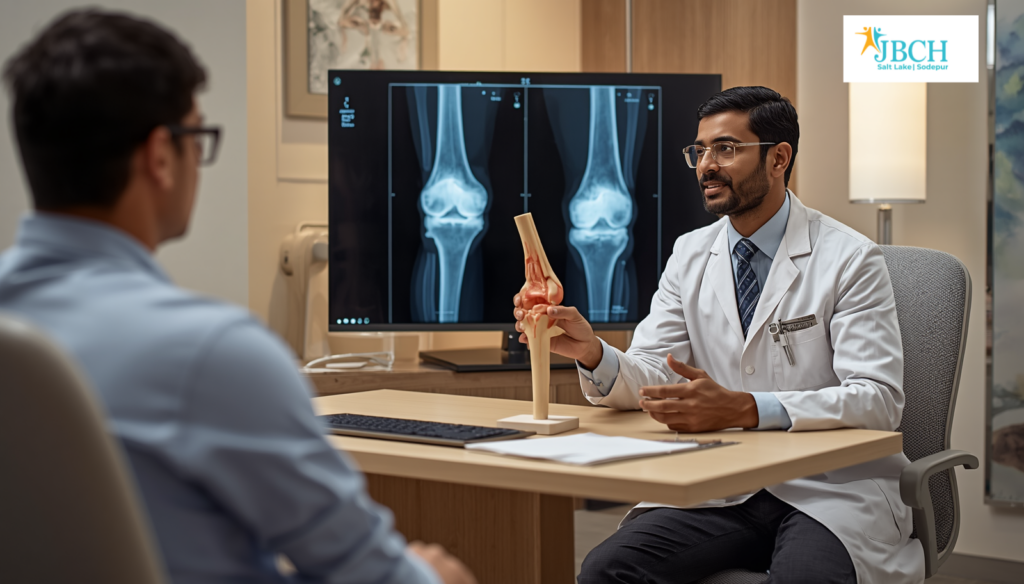
No good surgical journey starts in the operating theatre; it starts with an unhurried consultation. The Best Robotic Knee Replacement Surgeon in Kolkata spends this time examining your knee closely — measuring how far it bends and straightens, observing your walking pattern, testing ligament stability, and going through your medical history in detail.
You will then have standing weight-bearing X-rays. Taken while your body weight loads the joint, these films show the real picture: how much cartilage space remains, how much bone has worn away, and whether the leg has bent out of its natural line.
If robotic surgery suits your case, one more test is added — a high-resolution CT scan. Where an X-ray gives a flat image, the CT scan builds a complete 3D record of your femur (thigh bone), tibia (shin bone), and patella (kneecap), capturing their exact size, shape, curvature, and alignment.
Phase 2: A Surgical Plan Made Only for You
That CT data now becomes the foundation of your surgery. It is fed into the robotic system’s planning software, which constructs a three-dimensional digital replica of your knee — not an average knee, not a template, but yours.
On this virtual knee, your surgeon designs the entire operation in advance: which implant size fits best, the precise angle and depth of every bone cut, how the components should be rotated, and what the final alignment of your leg should look like. The software even lets the surgeon test different implant positions virtually and compare their effect on stability and movement before a single incision is made.
This is one of the biggest Precision Robotic Knee Surgery benefits — the operation shifts from being guided by estimation on the table to being guided by a proven, patient-specific blueprint prepared days in advance.
Phase 3: Surgery Day — Anaesthesia and Registration
On the morning of surgery, anaesthesia comes first. Most patients receive a regional block that numbs the lower half of the body while keeping them relaxed and comfortable.
Next comes a step unique to robotic surgery: registration. Tiny optical markers are fixed near the knee, and infrared cameras begin reading the live position of your thigh bone and shin bone. The system then overlays your pre-operative digital plan onto your actual anatomy — synchronising the virtual knee on the screen with the real knee on the table.
Your surgeon double-checks this synchronisation by moving the knee through multiple positions and confirming the on-screen model moves exactly as the joint does. The operation proceeds only after a perfect match — the kind of built-in safety discipline that defines a genuine Advanced Robotic Knee Clinic Near Me experience.
Phase 4: Robot-Guided Bone Preparation
Now the robotic arm takes its most visible role — though never an independent one. The surgeon holds and directs a cutting instrument mounted within the robotic arm, removing only the damaged bone surfaces. The robot’s job is discipline: it keeps the instrument locked within the boundaries defined in your surgical plan.
Should the blade drift toward the edge of that safe zone, the system resists the surgeon’s hand with haptic feedback — or stops the blade entirely. This prevents even a millimetre of unnecessary bone removal, one of the classic causes of implant malalignment in conventional surgery.
The outcome is a clean, conservative cut. Healthy bone is saved, and the ligaments and muscles around the joint are barely disturbed — which is precisely what patients are looking for when they search for minimally invasive Robotic Knee Replacement.
This tissue-friendly approach is also why many describe it as pain-free knee replacement technology. To be fully honest with you: some manageable soreness in the first days of recovery is normal and expected. But because muscle and ligament are preserved, the discomfort is usually far gentler than what patients fear going in.
Phase 5: Trial Fitting and Live Balancing
Before anything permanent is fixed, trial components go onto the freshly prepared bone surfaces. The surgeon then takes your knee through its full repertoire — bending, straightening, rotating — while the robotic screen streams live numbers: joint gaps, ligament tension, alignment angles.
Why does this matter so much? Because a knee in which the inner and outer ligaments carry load evenly through every degree of motion is a knee that feels natural. One that doesn’t is a knee that forever feels slightly “off.” Traditional surgery leaves this judgement to the surgeon’s hands alone; robotics adds hard numbers to that trained instinct.
Any imbalance the data reveals is corrected with micro-adjustments right there, before the final implant is committed. This measured, data-driven balancing is a major contributor to long-lasting knee implants with robotics — published clinical literature repeatedly connects accurate alignment and balanced soft tissue with better implant performance and longer survival.
Phase 6: Final Implant and Closure
With the trial fit and balance confirmed, the permanent implant is placed. Depending on the implant design and the quality of your bone, the components are either secured with bone cement or press-fitted so your bone gradually grows into them. A last check of stability and smooth motion follows, and the wound is closed neatly in layers.
Phase 7: Recovery — Your First Steps
Here is what surprises most patients: recovery starts the same day. Within hours, the physiotherapy team is at your bedside helping you sit up, do ankle pumps, and attempt gentle knee bends — and many patients stand with support before the day ends. By the next morning, supervised walking with a walker usually begins.
None of this is rushed for its own sake. Early movement improves circulation, keeps stiffness away, and wakes up the muscles around your new joint. And because the robotic approach spared more of your soft tissue, these first movements typically hurt far less than you expect.
Most patients go home within a few days, carrying a structured home physiotherapy plan and a schedule of follow-up visits to track healing and implant function.
Is Robotic Knee Replacement Affordable in Kolkata?
Naturally, patients want to know about the cost of robotic knee replacement in Kolkata. There is no single answer — the final figure depends on the implant you choose, the hospital category, your room preference, your insurance cover, and how long you stay.
The good news is real: as robotic systems spread across the city, Affordable Robotic Knee Surgery in Kolkata is now within reach of ordinary families, and a growing number of insurance policies and cashless schemes cover robotic-assisted procedures. Ask for a transparent, itemised estimate at your consultation — it is the most dependable way to plan your finances without surprises.
Choosing the Right Centre in Salt Lake, Kolkata
Owning a robot does not make a hospital a robotic surgery centre. What does is the full ecosystem: proven technology, a surgical team that performs these procedures regularly, and a structured patient pathway that supports you from the first consultation to long-term follow-up years later.
Every surgery carries some inherent risk — that is simply the truth of medicine. But robotic guidance, verification checkpoints at every phase, and an experienced team exist to press that risk down to the lowest level modern medicine allows. And now that you know what happens at each stage, uncertainty no longer needs to be part of your decision.
If knee pain has been shrinking your world, a one-on-one consultation with an experienced orthopaedic specialist is the right first step. JBCH Hospital in Salt Lake, Kolkata, is a centre patients across West Bengal can explore for Robotic Knee Replacement Surgery in Kolkata — where technology and an experienced team work together for your mobility.