From Scan to First Step – What Really Happens During Robotic Knee Replacement Surgery in Kolkata
Deciding to go ahead with knee replacement is a big moment, and for most patients the greatest anxiety comes from simply not knowing what happens inside the operating theatre. When a robotic arm and computer screens are part of the picture, the unknown can feel even more daunting.
This blog removes that mystery. We walk you through every phase of Robotic Knee Replacement Surgery in Kolkata — from the very first diagnostic scan to the moment you stand on your new knee — so that when your day arrives, nothing feels unfamiliar.
The First Consultation and Diagnostic Assessment
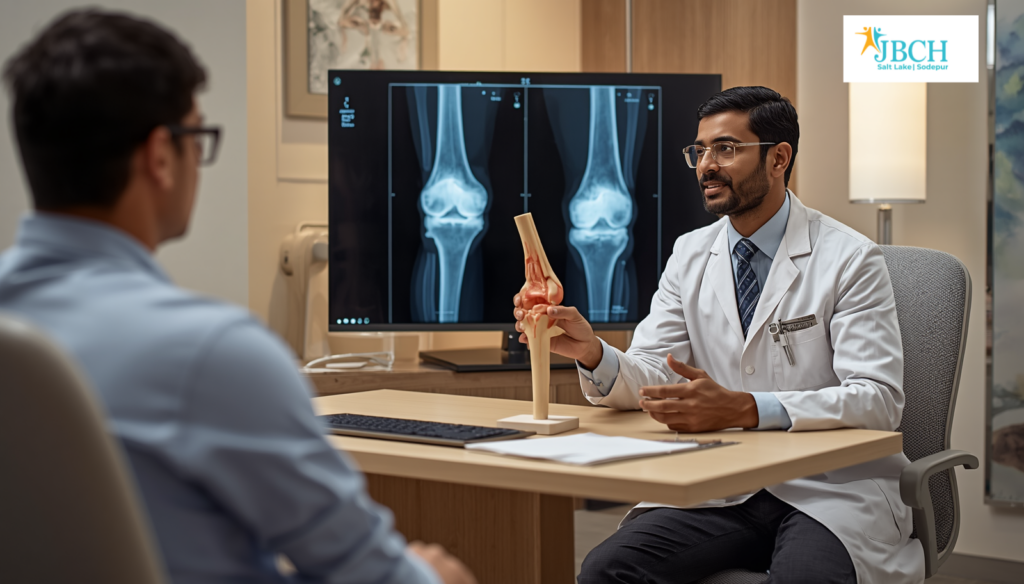
Everything begins with a detailed clinical evaluation. The Best Robotic Knee Replacement Surgeon in Kolkata will not rush this stage. Your orthopaedic specialist examines the knee, assesses your range of motion, studies your walking pattern, and reviews your complete medical history. Weight-bearing X-rays taken in the standing position reveal the true extent of joint space narrowing, bone damage, and alignment deformity.
If robotic knee replacement is found suitable for you, a high-resolution CT scan of the knee is ordered. Unlike a standard X-ray, the CT scan captures a complete three-dimensional picture of your femur (thigh bone), tibia (shin bone), and patella (kneecap) — including their exact dimensions, curvature, and current alignment.
Creating Your Personal Surgical Blueprint
The CT data is uploaded into the robotic system’s planning software, where a precise three-dimensional model of your knee is generated. This is not a generic template; it is a model unique to your anatomy.
On this virtual model, the surgeon maps out the operation in granular detail — the exact implant size, the angle and depth of every bone cut, the rotational alignment of the components, and the projected post-operative limb alignment. Different implant positions can be virtually tested to predict how each will affect stability and movement.
This planning phase is among the most important Precision Robotic Knee Surgery benefits. It converts the operation from one guided by intra-operative estimation into one guided by a validated, patient-specific blueprint.
Day of Surgery — Anaesthesia and Registration
After anaesthesia is administered — usually regional anaesthesia that numbs the lower body while keeping you comfortable — the team begins registration. Small optical tracking markers are placed near the knee joint, and infrared cameras allow the robotic system to track the real-time position of your femur and tibia. The pre-operative plan is overlaid onto your live anatomy, so the virtual blueprint and the physical knee are perfectly synchronised.
The surgeon verifies this by moving the knee through different positions and confirming the on-screen model mirrors the actual joint. Only when accuracy is confirmed does the procedure move forward — a safeguard that reflects how seriously an Advanced Robotic Knee Clinic Near Me approach treats patient safety at every stage.
Robotic-Guided Bone Preparation
Here the robotic system plays its most visible role. The surgeon uses a cutting instrument held within the robotic arm to remove only the damaged bone surfaces. The surgeon remains fully in control of the movement, while the robotic arm keeps the instrument strictly within the pre-planned boundaries.
If the instrument approaches the edge of the planned zone, the system provides haptic feedback or stops the blade automatically. This protects against removing more bone than necessary — a common cause of implant malalignment in conventional surgery.
The result is a clean, conservative resection. Less bone is sacrificed and the surrounding ligaments and soft tissues experience minimal disruption — exactly what patients mean when they search for minimally invasive Robotic Knee Replacement. This gentler approach to tissue is also why the technique is often described as pain-free knee replacement technology: by preserving muscle and ligament, post-operative discomfort is typically far milder than patients expect, though it is honest to say that some manageable soreness during early recovery is a normal part of healing.
Trial Fitting and Real-Time Balancing
Trial implant components are then placed on the prepared surfaces, and the knee is moved through its full range — bending, straightening, rotating — while the robotic system displays live data on joint gaps, ligament tension, and alignment.
A well-balanced knee, where the inner and outer ligaments share load evenly through the entire range of motion, is the difference between a knee that feels natural and one that feels “off.” Conventional surgery relies on the surgeon’s tactile judgement alone; robotic assistance supplements that clinical feel with objective, quantified data.
If any imbalance appears, the surgeon makes micro-adjustments before committing to the final implant. This data-driven balancing is a key reason behind long-lasting knee implants with robotics — accurate alignment and balanced soft tissue are strongly associated with better implant function and durability in published clinical literature.
Final Implant Placement and Closure
Once the surgeon is fully satisfied with the trial fit and balance, the final components are placed. Depending on the implant system and your bone quality, the components may be cemented or press-fitted for biological integration. After a final check of stability and motion, the wound is closed in layers.
Recovery and Early Mobilisation
Recovery begins almost immediately. Within hours of surgery, the physiotherapy team helps you sit up, perform ankle pumps and gentle knee bends, and — for many patients — stand with support. Supervised walking with a walker typically starts the very next morning.
Early movement is deliberate: it promotes circulation, prevents stiffness, and kick-starts muscle re-education. Because the robotic approach preserves more soft tissue, most patients tolerate early mobilisation with noticeably less discomfort than they anticipated. Discharge usually happens within a few days, followed by a structured home physiotherapy protocol and scheduled follow-up reviews to monitor healing and implant function.
Is Robotic Knee Replacement Affordable in Kolkata
A frequent question patients ask is about the cost of robotic knee replacement in Kolkata. The total expense depends on several factors — the implant type chosen, the hospital category, room preference, insurance coverage, and the length of stay. The encouraging reality is that as the technology becomes more widely adopted across the city, Affordable Robotic Knee Surgery in Kolkata is increasingly within reach for ordinary families, and many insurance and cashless schemes now extend to robotic-assisted procedures. A transparent, itemised estimate during your consultation is the most reliable way to plan your budget.
Choosing the Right Centre in Salt Lake, Kolkata
What separates a leading robotic joint replacement centre from one that merely owns a robotic system is the combination of advanced technology, a dedicated high-volume surgical team, and a structured end-to-end patient programme — from the first consultation through long-term follow-up.
While every surgical procedure carries some degree of inherent risk, robotic guidance, rigorous safety checks at every stage, and an experienced surgical team work together to keep that risk as low as modern medicine allows. Understanding the process removes uncertainty and builds the confidence you need to take the next step toward better mobility.
If you would like to understand how robotic knee replacement can help your specific condition, a one-on-one consultation with an experienced orthopaedic specialist is the best place to begin. JBCH Hospital in Salt Lake, Kolkata, is a centre that patients across West Bengal can explore for Robotic Knee Replacement Surgery in Kolkata.