
Robotic Knee Replacement vs Conventional Knee Replacement — Understanding the Real Differences
If you have been advised knee replacement surgery, you have likely encountered two terms: conventional (or traditional) knee replacement and robotic knee replacement. Both procedures share the same fundamental goal — replacing the damaged joint surfaces with artificial implant components to restore mobility and relieve chronic pain. But the way each procedure is planned and executed differs significantly, and those differences have a direct impact on accuracy, recovery, and how long the new knee lasts.
This blog offers a clear, side-by-side comparison to help you understand what sets Robotic Knee Replacement Surgery in Kolkata apart from the conventional approach — and why an increasing number of orthopaedic specialists and patients are choosing the robotic path.
The Core Difference: How the Surgery Is Planned
Conventional Approach
In a conventional knee replacement, the surgeon relies on two-dimensional X-rays to assess the knee’s condition before surgery. During the operation, mechanical alignment jigs and cutting guides — physical instruments placed on the bone — are used to direct the saw for bone cuts. The surgeon uses these tools along with their clinical experience and tactile judgement to position the implant correctly.
This method has been used successfully for decades and remains effective in experienced hands. However, it has inherent limitations. Mechanical jigs offer a generalised fit rather than a patient-specific one, and alignment accuracy depends heavily on the surgeon’s ability to interpret anatomical landmarks that are often distorted by arthritis or deformity.
Robotic Approach
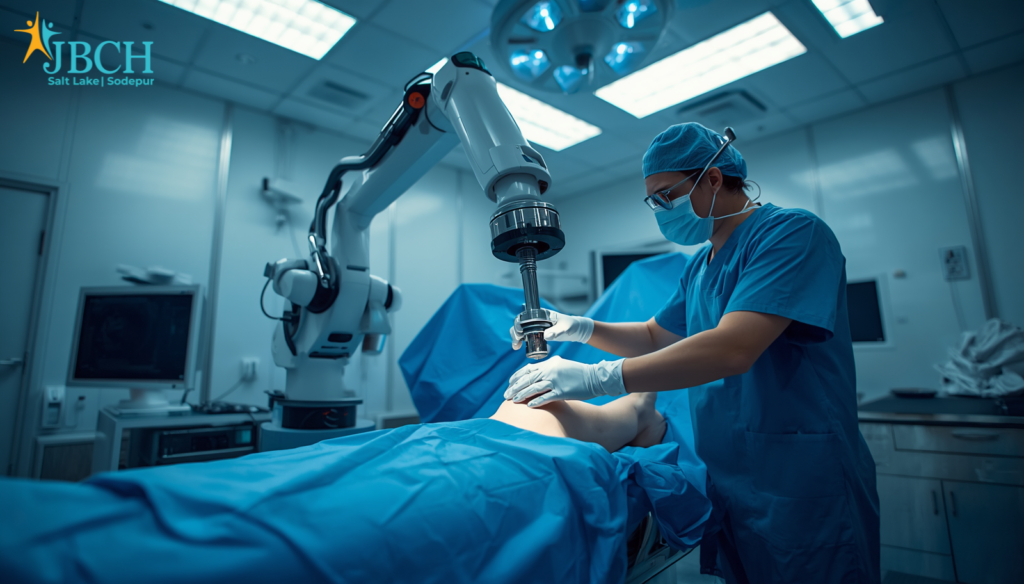
In robotic knee replacement, the process begins with a pre-operative CT scan that generates a detailed 3D model of the patient’s unique knee anatomy. The surgeon uses this model to pre-plan every bone cut — the exact angle, depth, and position — customised to that individual patient. During surgery, a robotic arm guides the cutting instrument along the pre-planned path, with real-time feedback and physical boundaries that prevent the saw from deviating.
This is the essence of precision robotic knee surgery benefits: every cut is planned in advance and executed with sub-millimetre accuracy, tailored specifically to the patient’s anatomy rather than relying on standardised guides.
Alignment Accuracy: Where Robotics Excels
Implant alignment is arguably the single most important factor in knee replacement success. Even a deviation of two to three degrees in the angle of the femoral or tibial component can lead to uneven load distribution, accelerated wear of the polyethylene liner, ligament strain, and ultimately, early implant failure.
Multiple peer-reviewed studies have demonstrated that robotic-assisted knee replacement achieves alignment within the planned target significantly more consistently than conventional techniques. In one widely cited analysis, over 95% of robotic cases achieved alignment within one degree of the surgical plan — a consistency rate that conventional surgery rarely matches.
This precision is directly linked to long-lasting knee implants with robotics. When the implant is positioned exactly as planned, load is distributed evenly across the joint surface, wear is minimised, and the prosthesis functions optimally for its full expected lifespan — often fifteen to twenty-five years or more.
Soft-Tissue Preservation: Less Damage, Better Recovery
One of the less discussed but clinically significant advantages of robotic surgery is soft-tissue preservation. In conventional knee replacement, the bone cuts are guided by mechanical instruments that offer limited control over how much surrounding tissue is affected. The saw moves freely once positioned, and controlling its exact path relies entirely on the surgeon’s manual steadiness.
In a minimally invasive robotic knee replacement, the robotic arm constrains the cutting instrument within defined boundaries. If the saw approaches the edge of the planned resection zone, the system resists or retracts. This means less unplanned bone removal, less disruption to the surrounding ligaments and muscles, and a cleaner surgical field overall.
The clinical result is meaningful: patients who undergo robotic knee replacement typically experience less post-operative swelling, reduced stiffness, and improved early range of motion compared to those who undergo conventional surgery. These differences are most pronounced in the first six to twelve weeks after the procedure.
Recovery Timeline: Robotic vs Conventional
Recovery after any knee replacement follows a physiotherapy-driven rehabilitation pathway. However, the speed and comfort of that recovery differ between the two approaches.
Conventional Knee Replacement Recovery
Most patients begin weight-bearing walking within one to two days of surgery. Hospital stay is typically three to five days. Return to daily household activities takes four to six weeks, with full recovery — including demanding activities like climbing stairs confidently or walking long distances — taking three to six months. Post-operative discomfort during early rehabilitation can be moderate to significant, requiring consistent pain management.
Robotic Knee Replacement Recovery
Because of the reduced tissue trauma, faster recovery knee replacement surgery with robotics is a documented advantage. Many patients begin walking with assistance within twelve to twenty-four hours. Hospital discharge often happens within two to three days. Return to daily activities is typically two to four weeks earlier than with conventional surgery, and the discomfort during early physiotherapy is generally more manageable.
This accelerated recovery is not just about physical comfort — it means less time away from work, less dependence on family members for daily tasks, and a quicker return to the activities that define a normal, independent life.
Joint Balancing: The Data Advantage
A well-balanced knee — one where the medial (inner) and lateral (outer) ligaments bear load evenly through the full range of motion — is essential for a knee replacement that feels natural. An imbalanced knee can feel tight, unstable, or “off,” and may require revision surgery to correct.
In conventional surgery, joint balancing is done through the surgeon’s tactile feel — manually assessing ligament tension during the operation. This is a skill that experienced surgeons perform well, but it remains subjective.
Robotic systems provide objective, real-time data on joint gaps and ligament tension at every degree of knee flexion. The surgeon can see quantified measurements on a screen, make micro-adjustments, and verify the result before finalising the implant position. This data-driven approach leads to more consistently balanced joints — and more consistently satisfied patients.
Robotic Knee Replacement vs Conventional Knee Replacement — Understanding the Real Differences
Who Benefits Most from the Robotic Approach
While robotic knee replacement benefits virtually all candidates, certain patient profiles see particularly significant advantages:
- Patients with complex deformities — severe bow legs (varus) or knock knees (valgus) — where conventional jigs struggle with distorted anatomy.
- Younger, active patients — who need the implant to last as long as possible and want to return to an active lifestyle quickly.
- Patients with stiff knees or limited pre-operative range of motion — where precise bone cuts and careful ligament balancing have a greater impact on functional outcomes.
- Bilateral knee replacement patients — undergoing both knees, where consistent precision across two procedures is critical.
Is Conventional Surgery Still a Good Option
Yes. Conventional knee replacement remains a well-established, clinically proven procedure with decades of outcome data. In the hands of an experienced, high-volume surgeon, conventional knee replacement delivers excellent results for many patients. It is important not to dismiss conventional surgery — rather, to understand that robotic surgery offers a measurable step forward in consistency, precision, and early recovery.
The choice between the two should be made in consultation with your Orthopaedic Surgeon, based on your specific knee condition, anatomy, lifestyle goals, and the surgeon’s experience with both approaches.
Patients across West Bengal seeking Robotic Knee Replacement Surgery in West Bengal now have access to this advanced approach at centres in Salt Lake, Kolkata, without needing to travel out of state. The technology is mature, the surgical teams are trained, and the outcomes are well-documented.
If you are weighing your options between conventional and robotic knee replacement, a consultation with a specialist who has experience in both approaches can help you make a well-informed decision. JBCH Hospital in Salt Lake, Kolkata, is a centre where patients can explore robotic knee replacement and understand which approach is right for their condition.