How to Find the Best Robotic Knee Replacement Surgeon in Kolkata — What Every Patient Should Evaluate
You have decided that knee replacement is the right step. Perhaps you have already read about robotic-assisted surgery and understand its advantages. Now comes a decision that will shape the entire outcome: choosing the right surgeon.
In a city like Kolkata, where the orthopaedic landscape has expanded rapidly, the options can feel overwhelming. Multiple hospitals advertise robotic capabilities, several surgeons list joint replacement as a speciality, and online reviews offer conflicting signals. How do you cut through the noise and identify the Best Robotic Knee Replacement Surgeon in Kolkata for your specific needs?
This guide gives you a structured framework to evaluate your options — based on clinical criteria, not marketing.
Understanding the Surgeon-Robot Relationship
Before evaluating surgeons, it helps to understand what the robot does and does not do. The robotic system is a precision tool. It holds cutting instruments steady, enforces pre-planned boundaries, provides real-time data on bone cuts and ligament tension, and prevents the saw from drifting into unplanned territory. What it does not do is think, adapt, or make clinical decisions.
Every decision — how much bone to remove, where to position the implant, how to balance the ligaments, how to handle unexpected findings during surgery — belongs entirely to the surgeon. The term Fully Automated Knee Replacement Surgery, while commonly used, refers to the computer-guided precision of the robotic system. The surgeon remains in complete control throughout.
This means the quality of your outcome depends on the surgeon’s skill as much as the robot’s accuracy. An experienced surgeon with a well-calibrated robotic system delivers far superior results compared to a less experienced surgeon with the same technology.
Five Criteria That Matter
1. Sub-Speciality Training in Joint Replacement
Orthopaedic surgery is a broad field covering trauma, spine, sports medicine, paediatrics, and more. Joint replacement — arthroplasty — is a distinct sub-speciality. Look for a surgeon who has completed a dedicated fellowship in knee arthroplasty, ideally with hands-on training on robotic platforms. This fellowship training goes well beyond the general orthopaedic residency and prepares the surgeon for the nuances of implant selection, alignment philosophy, and revision scenarios.
2. Robotic Case Volume
Experience matters enormously. Ask the surgeon specifically how many robotic knee replacements they have performed — not total knee replacements, but robotic ones. The learning curve for robotic surgery is well-documented; surgeons who have completed several hundred robotic cases operate with a fluency and efficiency that newer operators are still developing. High volume correlates with better outcomes, fewer complications, and shorter operative times.
3. Hospital Infrastructure and Robotic Platform
The surgeon operates within a system. The hospital’s operation theatre standards, sterilisation protocols, anaesthesia team, nursing care, and physiotherapy department all influence the outcome. A hospital that has invested in a clinically proven robotic platform — and trained its entire surgical team to work with it — will deliver more consistent precision robotic knee surgery benefits than a centre that has recently acquired the technology without building the supporting ecosystem around it.
When evaluating the Best Orthopedic Hospital for Robotic Surgery in Kolkata, look beyond the robotic arm itself. Consider whether the facility has a dedicated joint replacement unit, a full-time physiotherapy team, round-the-clock nursing care, and ICU backup. A top robotic joint replacement center in West Bengal will offer all of these as part of a structured, end-to-end programme — not just a machine in the operating theatre.
4. Transparent Communication
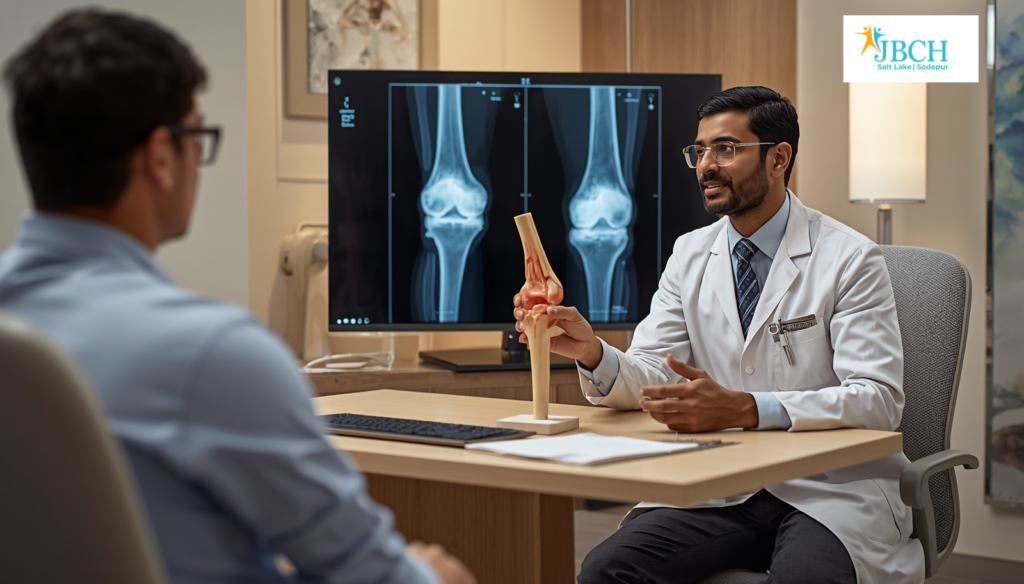
A skilled surgeon explains things clearly. During your consultation, you should receive a straightforward explanation of your knee condition, why surgery is being recommended, how the robotic approach applies to your specific anatomy, what the realistic recovery timeline looks like, and what outcomes you can expect.
Be cautious of surgeons who guarantee specific outcomes, promise unrealistic recovery timelines, or dismiss your questions. The best surgeons welcome informed patients — they know that understanding leads to better compliance, better rehabilitation, and ultimately better results.
5. Patient Outcomes and Follow-Up Protocol
Ask about measurable outcomes: the surgeon’s infection rate, revision rate, average hospital stay duration, and the follow-up protocol they maintain after discharge. A surgeon who tracks and shares outcomes data demonstrates accountability. Also inquire about the post-operative follow-up schedule — responsible surgeons monitor patients at regular intervals for at least a year after surgery.
The Role of the Hospital’s Wider Team
Knee replacement is not a one-person operation. The anaesthesiologist managing your sedation or regional block, the scrub nurse assisting in the operating theatre, the physiotherapist who begins your mobilisation within hours of surgery, and the nursing staff managing your post-operative care — they all contribute to the outcome. A well-coordinated team, practised in robotic knee replacement protocols, delivers a smoother, safer experience than a brilliant surgeon operating within a disjointed system.
This is why the hospital you choose matters as much as the surgeon. An advanced robotic knee clinic that has performed a high volume of robotic procedures as an institution — not just one individual surgeon — typically offers more refined workflows, better complication management, and more consistent results.
What About Second Opinions
Seeking a second opinion is not a sign of distrust; it is a responsible step in your healthcare journey. If you have been advised surgery by one orthopaedic surgeon, consulting another — especially one with specific robotic knee replacement expertise — can either confirm the recommendation or reveal alternative approaches. Most experienced surgeons respect and encourage this process.
Red Flags to Be Aware Of
Watch out for these warning signs when evaluating a surgeon or hospital:
- The surgeon recommends surgery at the very first consultation without adequate diagnostic workup.
- The hospital has recently acquired robotic technology but the surgical team has limited experience operating with it.
- The consultation feels rushed, with minimal time for your questions.
- No structured physiotherapy or rehabilitation programme is mentioned as part of the surgical plan.
How to Find the Best Robotic Knee Replacement Surgeon in Kolkata — What Every Patient Should Evaluate
Making a Confident Choice
Choosing a surgeon is ultimately about trust — trust that is built through verified credentials, transparent communication, demonstrated experience, and a hospital environment that supports excellence. Take your time, ask the right questions, and make your decision based on substance rather than advertisements.
In Salt Lake, Kolkata, patients have access to hospitals that offer this complete combination: fellowship-trained knee replacement specialists with extensive robotic experience, advanced robotic surgical platforms, and integrated post-operative rehabilitation programmes — all under one roof. This kind of structured, end-to-end approach is what gives patients both confidence and clarity at every stage of their surgical journey.
Choosing the right surgeon starts with the right conversation. If you would like to discuss your knee condition with a specialist who has hands-on robotic surgery experience, exploring your options early helps you make a well-informed decision. JBCH Hospital, Salt Lake, Kolkata, is a centre worth considering for its robotic knee replacement expertise.